Ebook Free Essays and Aphorisms (Penguin Classics), by Arthur Schopenhauer
It will not take even more time to download this Essays And Aphorisms (Penguin Classics), By Arthur Schopenhauer It will not take more money to print this publication Essays And Aphorisms (Penguin Classics), By Arthur Schopenhauer Nowadays, people have been so smart to use the modern technology. Why do not you utilize your device or other tool to conserve this downloaded soft data e-book Essays And Aphorisms (Penguin Classics), By Arthur Schopenhauer Through this will certainly allow you to consistently be gone along with by this book Essays And Aphorisms (Penguin Classics), By Arthur Schopenhauer Naturally, it will certainly be the very best good friend if you read this e-book Essays And Aphorisms (Penguin Classics), By Arthur Schopenhauer until finished.
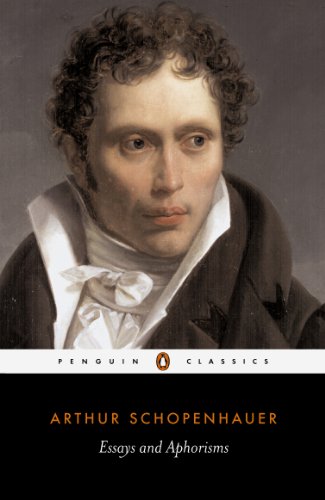
Essays and Aphorisms (Penguin Classics), by Arthur Schopenhauer

Ebook Free Essays and Aphorisms (Penguin Classics), by Arthur Schopenhauer
This is it the book Essays And Aphorisms (Penguin Classics), By Arthur Schopenhauer to be best seller lately. We provide you the very best offer by obtaining the incredible book Essays And Aphorisms (Penguin Classics), By Arthur Schopenhauer in this site. This Essays And Aphorisms (Penguin Classics), By Arthur Schopenhauer will not only be the sort of book that is hard to locate. In this internet site, all types of publications are given. You could browse title by title, writer by writer, and publisher by author to learn the very best book Essays And Aphorisms (Penguin Classics), By Arthur Schopenhauer that you could read now.
The reason of why you could receive and also get this Essays And Aphorisms (Penguin Classics), By Arthur Schopenhauer earlier is that this is guide in soft data form. You could review guides Essays And Aphorisms (Penguin Classics), By Arthur Schopenhauer any place you desire even you remain in the bus, office, residence, as well as other areas. Yet, you may not should move or bring guide Essays And Aphorisms (Penguin Classics), By Arthur Schopenhauer print any place you go. So, you won't have much heavier bag to lug. This is why your option making better concept of reading Essays And Aphorisms (Penguin Classics), By Arthur Schopenhauer is truly valuable from this case.
Knowing the method how you can get this book Essays And Aphorisms (Penguin Classics), By Arthur Schopenhauer is additionally useful. You have actually remained in best website to begin getting this information. Obtain the Essays And Aphorisms (Penguin Classics), By Arthur Schopenhauer web link that we supply here as well as see the web link. You could buy guide Essays And Aphorisms (Penguin Classics), By Arthur Schopenhauer or get it when possible. You can quickly download this Essays And Aphorisms (Penguin Classics), By Arthur Schopenhauer after getting deal. So, when you need guide swiftly, you could directly receive it. It's so easy therefore fats, isn't it? You should like to this way.
Merely connect your device computer system or gizmo to the web linking. Get the modern innovation making your downloading Essays And Aphorisms (Penguin Classics), By Arthur Schopenhauer finished. Even you don't wish to check out, you can straight shut guide soft data as well as open Essays And Aphorisms (Penguin Classics), By Arthur Schopenhauer it later on. You can also effortlessly get the book almost everywhere, since Essays And Aphorisms (Penguin Classics), By Arthur Schopenhauer it is in your gizmo. Or when being in the workplace, this Essays And Aphorisms (Penguin Classics), By Arthur Schopenhauer is also recommended to read in your computer gadget.
This selection of thoughts on religion, ethics, politics, women, suicide, books, and much more is taken from Schopenhauer's last work, Parerga and Paralipo-mena, published in 1851.
For more than seventy years, Penguin has been the leading publisher of classic literature in the English-speaking world. With more than 1,700 titles, Penguin Classics represents a global bookshelf of the best works throughout history and across genres and disciplines. Readers trust the series to provide authoritative texts enhanced by introductions and notes by distinguished scholars and contemporary authors, as well as up-to-date translations by award-winning translators.
- Sales Rank: #31102 in Books
- Color: Paperback,
- Brand: imusti
- Published on: 1973-05-30
- Released on: 1973-05-30
- Original language: German
- Number of items: 1
- Dimensions: 7.74" h x .59" w x 5.07" l, .62 pounds
- Binding: Paperback
- 240 pages
- Penguin Classics
Language Notes
Text: English, German (translation)
About the Author
Arthur Schopenauer was born in Danzig in 1788, where his family, of Dutch origin, owned one of the most respected trading houses. In 1793 the business moved to Hamburg, and in 1805 Arthur, who was expected to inherit it, was apprenticed as a clerk to another Hamburg house. He hated the work, so in 1807, two years after his father’s suicide and the sale of the business, he enrolled at the grammar school at Gotha. In 1809 he entered Göttingen University to study medicine and science; the following year he took up philosophy. In 1811 he transferred to Berlin to write his doctoral thesis (1813). During the next four years he lived in Dresden and wrote The World as Will and Idea (1818), a complete exposition of his philosophy. Although the book failed to sell, Schopenhauer’s belief in his own philosophy sustained him through twenty-five years of frustrated desire for fame. During his middle life, he traveled widely in Europe. In 1844 he brought out a greatly expanded edition of his book, which after his death became one of the most widely read of all philosophical works. His fame was established in 1851 with the publication of Parerga and Paralipomena, a large collection of essays, dialogues and aphorisms. From 1833 until his death from a heart attack in 1860 he lived in Frankfurt-am-Main.
R. J. Hollingdale has translated eleven of Nietzsche’s books and published two books about him. He has also translated works by, among others, Schopenhauer, Goethe, E. T. A. Hoffmann, Lichtenberg and Theodor Fontane, many of these for the Penguin Classics. He is Honorary President of the British Nietzsche Society, and was for the Australian academic year 1991 Visiting Fellow at Trinity College, Melbourne.
Most helpful customer reviews
7 of 7 people found the following review helpful.
Schopenhauer at his best
By Glenn Russell
Arthur Schopenhauer wrote his essays and aphorisms in the financial hub city of Frankford, Germany during the mid-nineteenth century, a world where business owners and financiers ruthlessly competed against one another to amass fortunes, clerks chained to their desks toiled twelve hours a day, uneducated day laborers ground themselves down into faceless, mindless cogs of the urban wheel, and upper class ladies strolled the streets with parasols as they chattered incessantly over petty concerns - but, no matter what one's station in life - ruthless financial baron, toiling clerk, chattering lady or manual drudge - the monotonous hum of this bustling society gave few people encouragement or mental space to think independently or reflect philosophically. But no hustle and bustle for Arthur. Inheriting the family fortune and thus freed from any obligation to work for a living, Schopenhauer became a life-long bachelor and independent scholar, keeping his distance from other people as if they were a colony of doltish, novel-reading lepers. And, thus, after rousing in the morning and before playing the flute, partaking of lunch, and going for his two hour walk with his pet poodle, Schopenhauer sat at his desk, completely dedicating his time to writing. And this collection is Schopenhauer at his hyper-arrogant best, as self-appointed genius and highbrow aesthete, shooting verbal barbs and passing harsh judgment on everyone and everything in sight - would-be philosophers, journalists, bookworms, scholars, literati, historians, women, among numerous others.
This book is great literature as well as original philosophy, the writing is so incredibly clear, crystal clear, actually - a straightforward, easy-to-follow, elegant prose. What a switch from hopelessly dry, turgid, stale academic philosophy with its endless references, footnotes and qualifications. On the topic of books and writing, here is a quote which is vintage Schopenhauer: "The thoughts a man is capable of always express themselves in clear, comprehensible and unambiguous words. Those who put together difficult, obscure, involved, ambiguous discourses do not really know what they want to say: they have no more than a vague consciousness of it which is only struggling towards a thought; often, however, they also want to conceal from themselves and others that they actually have nothing to say." Keep this in mind the next time you read an incomprehensible piece of writing - in truth, the burden is on the writer to make their thoughts clear, no matter how impressive the author's credentials.
Among the topics address is aesthetics. As always, Schopenhauer never dances around an issue but goes right to the heart of the matter and tells it like it is. Here is what he has to say on opera: "Strictly speaking one could call opera an unmusical invention for the benefit of unmusical minds." For anybody with a keen interest in listening to music, these words have a very honest ring.
Here is a quote that is especially appropriate to our current age of information: "Students and learned men of every kind and every ago go as a rule in search of information, not insight. They make it a point of honor to have information about everything . . . When I see how much these well-informed people know, I sometimes say to myself: Oh, how little such a one must have had to think about, since he has had so much time for reading!" The truth of this statement is compounded with the omnipresence of the internet.
One more quote, this one capsulizing Schopenhauer's famous pessimistic view of life: "No rose without a thorn. But many a thorn without a rose." Even if you don't agree, you have to admire a brilliant, memorable metaphor. If you are new to Schopenhauer or philosophy, R. J. Hollindale provides an introduction which includes a mini-history of philosophy leading up to Schopenhauer, the cultural, literary and social context of Germany in the nineteenth century, as well as a mini-biography of Schopenhauer. This will be all you will need to have a rich appreciation for one of the most lucid and influential philosophers in the Western tradition.
2 of 2 people found the following review helpful.
Great Book Even If You're a Beginner
By Andrew Martin
This is one of the better books that I've read. Do not be worried if you are unfamiliar with Metaphysics, the book has an introduction which really introduces you to the author and the topics discussed. If you have no background in philosophy (like me) you'll be fine.
The book is great because it is simply a collection of a smart man's thoughts. You can learn a lot really quickly since most of them are short and to the point. He covers many different topics that are not touched today like Women and Suicide. You won't agree with everything that is written, but you will be presented with a different perspective. (which is the point of the book)
3 of 3 people found the following review helpful.
Timeless Wit & Wisdom
By Matthew Jackson
Schopenhauer gazes at life & humanity through an unfiltered lens and unashamedly exposes its immutable facts and truths no matter how unpleasant they may be. As a consequence , he pays the penalty of being forever cast as a dour, misanthropic polemicist and cynic. Nevertheless,you'll be awakened by his keen insights and observations and invariably be rewarded with some golden nuggets of timeless wisdom to place in your treasure chest of knowledge.
Schopenhauer's was truly one of the greatest among the 19th century philosophers whose work and ideas went on to strongly influence the likes of Nietzsche, Freud, and Wittgenstein.
Essays and Aphorisms (Penguin Classics), by Arthur Schopenhauer PDF
Essays and Aphorisms (Penguin Classics), by Arthur Schopenhauer EPub
Essays and Aphorisms (Penguin Classics), by Arthur Schopenhauer Doc
Essays and Aphorisms (Penguin Classics), by Arthur Schopenhauer iBooks
Essays and Aphorisms (Penguin Classics), by Arthur Schopenhauer rtf
Essays and Aphorisms (Penguin Classics), by Arthur Schopenhauer Mobipocket
Essays and Aphorisms (Penguin Classics), by Arthur Schopenhauer Kindle

No comments:
Post a Comment