Free PDF The Absent Superpower: The Shale Revolution and a World Without America, by Peter Zeihan
The Absent Superpower: The Shale Revolution And A World Without America, By Peter Zeihan. The industrialized innovation, nowadays sustain every little thing the human requirements. It consists of the daily activities, jobs, workplace, home entertainment, as well as a lot more. One of them is the wonderful web connection and computer system. This problem will certainly alleviate you to support among your hobbies, checking out practice. So, do you have going to read this book The Absent Superpower: The Shale Revolution And A World Without America, By Peter Zeihan now?
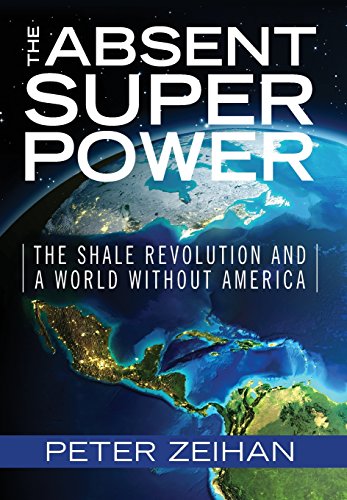
The Absent Superpower: The Shale Revolution and a World Without America, by Peter Zeihan

Free PDF The Absent Superpower: The Shale Revolution and a World Without America, by Peter Zeihan
Suggestion in picking the best book The Absent Superpower: The Shale Revolution And A World Without America, By Peter Zeihan to read this day can be obtained by reading this resource. You can find the very best book The Absent Superpower: The Shale Revolution And A World Without America, By Peter Zeihan that is marketed in this globe. Not just had actually guides released from this country, yet likewise the other countries. And also currently, we suppose you to read The Absent Superpower: The Shale Revolution And A World Without America, By Peter Zeihan as one of the reading products. This is just one of the very best books to gather in this website. Look at the web page as well as browse the books The Absent Superpower: The Shale Revolution And A World Without America, By Peter Zeihan You can find lots of titles of guides supplied.
Checking out, once again, will provide you something new. Something that you do not know then revealed to be populared with guide The Absent Superpower: The Shale Revolution And A World Without America, By Peter Zeihan message. Some understanding or lesson that re received from checking out books is vast. A lot more publications The Absent Superpower: The Shale Revolution And A World Without America, By Peter Zeihan you review, more understanding you obtain, as well as much more possibilities to constantly enjoy reading publications. As a result of this reason, reviewing book should be started from earlier. It is as exactly what you could acquire from the publication The Absent Superpower: The Shale Revolution And A World Without America, By Peter Zeihan
Obtain the benefits of reviewing routine for your life style. Book The Absent Superpower: The Shale Revolution And A World Without America, By Peter Zeihan message will certainly always associate to the life. The reality, understanding, science, health, religious beliefs, entertainment, and also more can be discovered in written e-books. Several authors provide their encounter, scientific research, research, and all things to share with you. Among them is with this The Absent Superpower: The Shale Revolution And A World Without America, By Peter Zeihan This publication The Absent Superpower: The Shale Revolution And A World Without America, By Peter Zeihan will provide the needed of message as well as statement of the life. Life will certainly be finished if you know a lot more points via reading e-books.
From the explanation above, it is clear that you require to review this book The Absent Superpower: The Shale Revolution And A World Without America, By Peter Zeihan We offer the online e-book qualified The Absent Superpower: The Shale Revolution And A World Without America, By Peter Zeihan right here by clicking the web link download. From discussed e-book by on the internet, you could give much more perks for lots of people. Besides, the viewers will be likewise quickly to obtain the preferred book The Absent Superpower: The Shale Revolution And A World Without America, By Peter Zeihan to read. Find the most favourite and required book The Absent Superpower: The Shale Revolution And A World Without America, By Peter Zeihan to read now as well as right here.
The world is changing in ways most of us find incomprehensible. Terrorism spills out of the Middle East into Europe. Russia, Iran, Saudi Arabia, China and Japan vie to see who can be most aggressive. Financial breakdown in Asia and Europe guts growth, challenging hard-won political stability.
Yet for the Americans, these changes are fantastic. Alone among the world's powers, only the United States is geographically wealthy, demographically robust, and energy secure. That last piece -- American energy security -- is rapidly emerging as the most critical piece of the global picture.
The American shale revolution does more than sever the largest of the remaining ties that bind America's fate to the wider world. It re-industrializes the United States, accelerates the global order's breakdown, and triggers a series of wide ranging military conflicts that will shape the next two decades. The common theme? Just as the global economy tips into chaos, just as global energy becomes dangerous, just as the world really needs the Americans to be engaged, the United States will be...absent.
In 2014's The Accidental Superpower, geopolitical strategist Peter Zeihan made the case that geographic, demographic and energy trends were unravelling the global system. Zeihan takes the story a step further in The Absent Superpower, mapping out the threats and opportunities as the world descends into Disorder.
- Sales Rank: #28296 in Books
- Published on: 2017-01-01
- Original language: English
- Number of items: 1
- Dimensions: 9.21" h x .94" w x 6.14" l,
- Binding: Hardcover
Review
"Peter Zeihan has written a smart, well-crafted page-turner that lays out the compelling reasons why America's role in the world has changed--and why that's good news for Americans and sobering for everyone else. His vivid account of the impact of America's good fortune for the rest of the world makes this an original and invaluable read." -- Ian Bremmer, Eurasia Group
"Zeihan follows his groundbreaking analysis of the post-WWII global geopolitical and economic system in Accidental Superpower with a projection of what might happen whenthe U.S., because of its new energy security and dynamic economy based on the shale revolution, withdraws from its principle role as security guarantor of the global order. Peter builds on prodigious objective demographic, energy,economic and geopolitical indicators to frame provocative scenarios based onthe impact of an American inward focus to the exclusion of international order. Delivered with his trademark irreverent wit, this book should be a must readfor public and private leaders alike. If President Trump has but one book to read as he assumes command, it should be this one." -- Honorable Dave McCurdy, Memberof U.S. House of Representatives (D - Ok, 1981-1995), served as chairman of theHouse Intelligence Committee during the breakup of the Soviet Union and throughoutOperation Desert Storm. President and CEO of the American Gas Association.
"TheAbsent Superpower is a must-read to understand the forces that will shapegeopolitics and potentially ignite decades of global disorder. By dissectingthe technological and geographic realities of energy and demography, Zeihan forecasts theconflicts and economic realignments that will follow America's withdrawal fromactive global leadership." -- Mitt Romney, former governor of Massachusetts and Republican presidential candidate
About the Author
Geopolitical Strategist Peter Zeihan is a global energy, demographic and security expert who marries the realities of geography and populations to a deep understanding of how global politics impact markets and economic trends, helping industry leaders navigate today's complex mix of geopolitical risks and opportunities. With a keen eye toward what will drive tomorrow's headlines, his irreverent approach transforms topics that are normally dense and heavy into accessible, relevant takeaways for audiences of all types. Zeihan founded his own firm -- Zeihan on Geopolitics -- in 2012 in order to provide a select group of clients with direct, custom analytical products. Today those clients represent a vast array of sectors including energy majors, financial institutions, business associations, agricultural interests, universities and the U.S. military. Prior to his independent life, Zeihan put in stints at the U.S. State Department, the DC think tank community, and Stratfor, one of the world's premier private intelligence companies, where he served as vice president of analysis. He regularly contributes to a wide array of media including the New York Times, the Washington Post, Forbes, the Associated Press, Bloomberg News, CNN, CNBC, Fox News, National Public Radio, Market-Watch, and others. His freshman book, The Accidental Superpower, debuted in 2014.
Most helpful customer reviews
28 of 28 people found the following review helpful.
Absent Superpower, a great sequel to Accidental Superpower.
By Abacus
In 2014, the author wrote a fascinating book “The Accidental Superpower.” It described how the U.S. benefits from a combination of geographic factors including maritime advantages (navigable river ways, natural harbors making for a network of low cost transportation), an ideal location from a security standpoint (an island-continent protected by huge oceans on each side, and surrounded by two friendly neighbors integrated in NAFTA). Additionally, the U.S. also benefits from material demographic advantages whereby the U.S. population is not aging nearly as fast if at all compared to Japan, China, and Europe (graph on pg 111 shows a spectacular difference in aging demographic trend through 2040 between the U.S. and the other countries). Its labor force will continue growing unlike in Japan and Russia where it is shrinking catastrophically rapidly. Zeihan also added near the end of the book that the emergence of shale oil production will render the U.S. increasingly energy independent.
In 2014 Zeihan anticipated that as the U.S. is becoming self-sufficient on all counts, its foreign policy will become more isolationist and protectionist (anti-trade. The U.S. will become less (financially) supportive of NATO and worldwide maritime routes security (end of Bretton Woods era). Three years later everything Zeihan anticipated did occur. And, it can be summed up in one word: Trump! Zeihan indicated in his newsletter that if Hillary had won the election, the U.S. policy path would be identical but carried out at a slower pace.
Within “The Accidental Superpower” Zeihan explored the fate of various countries and supranational entities including Russia, China, Japan, Europe and the Euro Zone in particular. In each case, their respective situation for one or more geographical and demographic factors is far less favorable than for the U.S. making unlikely that another hegemon will rise to replace the U.S.
By the time, Zeihan published his first book Saudi Arabia undertook an aggressive oil price war by pumping oil supply and lowering oil prices at time down to the low $40s. It was perceived that this was to bankrupt the U.S. shale oil industry. And, it seemed to be successful as many shale oil operations shut down at least temporarily.
So, now over two years later Zeihan comes with an update “The Absent Super Power.” However, while his first book was focused on water ways (a factor ignored by the international economics literature), he is now focusing on U.S. shale oil as the subtitle of the book indicates.
In the first part of the book Zeihan indicates how the U.S. shale oil industry experienced a drastic improvement in efficiency in response to the Saudis oil price war. On page 46, he shares a graph that indicates the U.S. shale oil industry lowered its breakeven point from $90 per barrel in 2012 down to $40 in 2017. Its breakeven point is now lower than for the U.S. traditional oil industry! And, it has matched Russia, a low cost oil producer. Only Saudi Arabia has a markedly lower breakeven point at around $25. Other OPEC countries are in the mid $30s (not much lower than U.S. shale). One should keep in mind that Saudi Arabia’s oil operations can break even at $25, however its’ fiscal balance requires oil prices closer to a $100 to avoid running large Budget Deficits. At $25, Saudi Arabia’s Budget Deficit would probably be over 20% of GDP.
U.S. shale oil has improved its efficiency by developing new technologies including micro-seismic exploration and multilateral drilling that leverages Big Data live information. The improved technology allows the industry to improve its success rate and efficiency. Because of those improvements, even though the industry was closing down many shale operations during the price war, the remaining survivors produced a lot more oil per rig than ever before (graph pg. 29). And, the overall shale oil output held up (see graph pg. 67).
U.S. shale exploration guarantees a low cap on U.S. oil price and an abundance of low cost natural gas. And, the latter is associated with abundant electricity generation at a lower cost than major OECD competitors. This is an advantage that may contribute to the reindustralisation of the U.S. And, lower energy costs (petroleum and natural gas) have implications affecting numerous part of the consumer, chemical, pharmaceutical, and industrial product sectors (diagram on pg. 63).
U.S. shale energy is based on numerous competitive advantages that include geology (maritime shale is easier to extract than lacustrine shale), law (U.S. is among few countries that fully implement private mineral rights), labor specialization (largest body of proficient engineers specializing in shale exploration), capital availability (best risk capital infrastructure), and as mentioned the best shale energy exploration technology. Those competitive advantages are not fully replicable anywhere else. Thus, the U.S. is likely to remain the leader in this sector for a very long time.
As a consequence of the emergence of U.S. shale oil, the international oil markets will fragment into at least two (if not more) separate markets: a) a US domestic one where prices will be chronically low and not volatile; and b) the traditional international one where prices will be a lot more volatile and have frequent spikes at or above $100 even $150 associated with Gulf crisis, wars, etc.
In the second and main part of the book, Zeihan describes “The Disorder” where he describes the falling apart of the existing Bretton Woods era. Per Zeihan, the World Order is going to fracture along three sets of wars that he defines as: 1) the Twilight War; 2) the Next Gulf War; and 3) the Tanker War.
In the Twilight War, he describes how Russia in order to preempt its unfortunate geography (flat and vulnerable to attacks) and demography (rapidly shrinking population) will attempt to rebuild the USSR by either invading or controlling former satellite countries (he designates 11 such countries on pg. 138). Russia has started on this venture with Georgia, and Ukraine. But, it will want to venture as far into Western Europe as part of Poland! By attempting this land grab, Russia will have much friction with both Scandinavia and Turkey; but such prospective conflicts will experience stalemate without shift in borders or control from existing arrangements.
The Next Gulf War is really about the tension between Iran (Shiites) and Saudi Arabia (Sunnis) who both compete for supremacy in the Region. And, the U.S. will stop policing the area as it becomes increasingly energy independent. The U.S. very soon will not need Saudi Arabia anymore as the U.S. imports are steadily declining. And, whatever oil it imports comes a lot more from Canada and a lot less from Saudi Arabia. Zeihan reveals that the Saudis oil price war started in 2014 was not so much or only aimed at the U.S. shale oil industry; but, it was particularly aimed at Iran. When oil revenues drop because of lower oil prices, both countries run huge Budget Deficits in the 10% to 15% range of GDP. And, the Saudis have a lot more cash reserves than Iran. The Saudis can afford such Deficits for years, Iran can’t. Meanwhile, Iran has superior military capabilities and will attempt to reconquer portions of the Persian Empire. The tension and conflict between Iran and Saudi Arabia will trigger collateral damage throughout the region. “several of the Middle Eastern countries … will lose so much industrial, electrical, and agricultural capacity that they will … de-civilize. Syria, Iraq, Jordan, Yemen, Lebanon … will lose the ability to maintain populations more than one-third their current size.” (pg. 208).
The Tanker War is about oil importing countries waging maritime operations and wars to protect their access to oil energy. Those operations will take place in the Far East. And, Japan will play a preponderant role thanks to its strong navy. “Destroy global free trade, unleash the Japanese, and the end of China is nigh… Simply put, the days of China Inc. and Factory Asia are over.” (pg. 258-259). The tension between China and Japan in protecting their respective access to oil energy will affect the entire Far East. The region will be plagued by far higher energy prices/costs than any others because it is so much more energy dependent. Zeihan frequently refers to the “Asian premium.”
The last chapter of the Part II: Disorder is on the international private major companies. Once again the Americans (ExxonMobil and Chevron) are the dominant players in technology, global reach, and capital. By contrast BP has been pretty much wiped out in the aftermath of its Deepwater Horizon oil rig disaster in the Gulf of Mexico in 2010.
Near the end of the book, Zeihan describes how the U.S. will engage (relatively minimally) in the World. He describes the U.S. foreign policy as “Dollar diplomacy.”
The U.S. will implement its Dollar diplomacy with Southeast Asia and Australia and New Zealand. The U.S. will continue to maintain close trade and direct investment ties with this region to recreate supply chains to replace or diversify away from relying on China’s manufacturing.
During the Disorder’s China manufacturing capacity may weaken significantly as the country experiences a convergence of crises including a debt crisis, a bank credit crisis, an aging population and shrinking labor force crisis, and much geopolitical frictions (the Tanker War).
The U.S. will use its Dollar diplomacy throughout Latin America. The region has substantial energy assets including a promising shale oil area in Argentina. But, because of mismanagement the region has not properly utilized those energy assets. The U.S. brings the technology, security, management know-how, and logistics assistance. The U.S. will shift also some of its former supply chains away from China towards Latin America. The U.S. is by far the largest consumer market that will remain a viable trading partner during the Disorder. And, Latin America needs the income that will be generated by the U.S. Dollar diplomacy to repay its foreign debt and feed its people. In summary, Latin America will have no choice but to accept the U.S. terms on their joint energy exploration.
In the appendices of the book, Zeihan addresses environmental concerns associated with shale oil. Within this section he conveys a couple of fascinating facts. On pg. 385, he shares a graph that depicts a time series of the estimated temperature increase caused by a doubling of CO2 based on studies completed between 2001 and 2014. And, back in 2001 this estimated temperature increase ranged from + 2.5 to 4.0 degree Celsius. The more recent estimates have shrunk it down to + 1.5 to 2 degree Celsius. That’s a huge difference. Later in this section, he reviews the prospect of renewables (wind, solar). And, they are just not scalable enough to make much of a dent in the overall energy mix. Those energy sources are intermittent, not easily storable and transmissible. Only a small fraction of the earth provides favorable conditions for either. He sees as a more realistic path to reduce CO2 emission the increasing substitution of coal with natural gas (to generate electricity) and increasing energy efficiency.
I have a few rebuttals to Zeihan’s theories.
First, Zeihan’s main point is that the U.S. is now pretty much a self-sufficient economy that does not need much to trade with other nations. Therefore, it does not need to maintain the supranational Bretton Woods order (NATO, security of maritime routes, etc.). However, when looking at the Bureau of Economic Analysis time series focusing on the trade of goods only (not services) imports have risen from 1.6% of GDP in 1942 to 12.7% in 2015. Similarly, exports of goods have risen over the same period from 1.6% to 8.3%. This is not an isolationist nation, but instead one that is increasingly becoming a hub of industrial design whereby the actual goods are manufactured and assembled out of the U.S. By the same token, the U.S. runs a resulting chronic large Current Account Deficit. As a result, foreigners hold a substantial portion of U.S. Treasuries. In summary, economic trends suggests the U.S. is increasingly codependent with the World in both international trade and international capital flows. Those are not bad things, but they run in opposite direction of Zeihan’s theoretical foundation.
Now, focusing on the U.S. energy independence. Even using Zeihan’s own compiled data, I found divergence. On pg. 406, his data conveys the U.S. only produces 65% of the crude oil and natural gas it consumes. Using Zeihan’s numbers, even if we assume Canada would commit 100% of its exports to the U.S. it would fill less than half that gap. It is difficult to come up with a precise estimate, but I suspect that US production + Canada’s imports equal less than 80% of U.S. consumption. “Energy independence” is somewhat premature.
Another chronic weakness of the U.S. is its deteriorating fiscal outlook. The U.S. over the next couple of decades will face structural unsustainable yearly Budget Deficits in the 4%+ range that will rapidly grow the U.S. Debt/GDP ratio uncontrollably (Congressional Budget Office is a good source on the topic). The Government has been aware of this situation for over three decades and has done nothing to resolve it. Similarly, at the State and local level finances are strained (Pension crisis). Infrastructure is not well maintained (electricity grid, bridges, roads). Zeihan ignores entirely those fiscal weaknesses at all levels of U.S. Government.
Another weakness is the U.S. consistently poor showing in international education standards comparison (PISA). This has to result in a shortage of American engineers, mathematicians, and scientists that has unfavorable implication in the current Big Data-Artificial Intelligence race. It would appear key for the U.S. to remain open to immigrants with human capital. However, the current political discourse does not seem favorable to that.
Despite the few rebuttals mentioned above, I give the book a 4-star rating for the originality of the argument and the depth of the research.
2 of 2 people found the following review helpful.
As the US moves on from the world it fashioned after WW2 ! - What's next?
By Jockular
AS Prez Trump skips school, Prof. Peter Zeihan answers the absent pupil's question "what the hell is going on".
By this I mean, Zeihan dives deep into the "big picture" (of geography, demography and energy) which have been dismantling the post-WW2 period the US forged at Bretton Woods 70 years ago..
Even more useful is Zeihan's projection of the world which will replace Bretton Woods, when US guaranteed and enforced "freedom of the seas" and Pax Americana through a global network of security alliances under the US nuclear umbrella unravel.
3 lregional wars are deemed likely as the guarantor, enforcer and referee exits the stage:
-- Russia vs. the Baltics, Scandinavians, and Poland
-- Iran vs. Saudi Arabia for dominance of Islam
-- China vs. Japan for control of the China seas, and of shipping routes for mideastern oil to Asia.
Given energy self-sufficiency from shale, the US is no longer obligated to participate. As it chooses, the US will intervene not with ground troops, but via aircraft carriers, jet fighters and drones. Special forces and cyber will round out the arsenal.
If any of these wars in fact materialize, oil prices outside N.America will likely be driven to $150/bbl. Shale oil (extracted with ever greater efficiency and cost cutting) will keep US prices below $70/bbl in all states but California.
The "golden state" imports most of its oil from the Middle East and Alaska. These producers will turn away to overseas markets willing to pay higher prices. California either develops the Monterrey shale timely (3 years before hostilities) or pays $5-6 more than other states for its oil.
News you can use, even if only part of these predictions come to pass. They make our Dear Leader's bluster seem rather unnecessary. All that's needed is to educate the world as to why the Bretton Woods era must end. This could be done graciously, but it likely won't be.
This points up 2 of Zeihan's blindspots: 1. leadership and 2. cyber.
The last time major powers evolved (Germany and Japan) world leaders failed to accommodate them into the global system. As a result, tens of millions died prematurely. Will today's leaders rise above their national interests to accommodate and shape China's role?
Cyberwar elevates Russia, China, and Iran to near US level. How many more countries can field hacker teams of a dozen or two world-class minds, and become big-league players in cyberwarfare?
If the US is really intent upon departing the world stage for a few decades, it might be wise NOT to antagonize those most threatened by its absence. No joke!
10 of 11 people found the following review helpful.
I can't recommend his work highly enough
By Kirk
I find Peter's writing and presentations to be extremely informative and engaging. I can't recommend his work highly enough. I pushed his previous book, The Accidental Superpower, on several of my friends and family; all were blown away by the clarity and depth Peter provided. The Absent Superpower is another home run. From the description of various fracking technologies to country by country analysis, I know I am more prepared to digest the news of tomorrow in a coherent fashion.
For example, as a Californian, I sincerely hope the Monterey Shale has the potential Peter laid out! Peter's predicts a retreating America; which would let the Persian Gulf tensions severely hamper the production/transport of its oil. California would mostly be cut off the Persian Gulf supplies, apparently Alaska has a loophole to get around an export ban, and South American oil would get bid up by desperate Asian countries. I knew none of this until I was introduced to Peter's work. Excellent job Peter!
See all 56 customer reviews...
The Absent Superpower: The Shale Revolution and a World Without America, by Peter Zeihan PDF
The Absent Superpower: The Shale Revolution and a World Without America, by Peter Zeihan EPub
The Absent Superpower: The Shale Revolution and a World Without America, by Peter Zeihan Doc
The Absent Superpower: The Shale Revolution and a World Without America, by Peter Zeihan iBooks
The Absent Superpower: The Shale Revolution and a World Without America, by Peter Zeihan rtf
The Absent Superpower: The Shale Revolution and a World Without America, by Peter Zeihan Mobipocket
The Absent Superpower: The Shale Revolution and a World Without America, by Peter Zeihan Kindle
The Absent Superpower: The Shale Revolution and a World Without America, by Peter Zeihan PDF
The Absent Superpower: The Shale Revolution and a World Without America, by Peter Zeihan PDF
The Absent Superpower: The Shale Revolution and a World Without America, by Peter Zeihan PDF
The Absent Superpower: The Shale Revolution and a World Without America, by Peter Zeihan PDF